Retirement Planning 2026: Save $1 Million by Age 65

Anúncios
Achieving a $1 million retirement nest egg by age 65 requires strategic planning starting in 2026, encompassing smart investing, diligent saving, and understanding various financial vehicles to secure your future.
Anúncios
Embarking on a journey towards a comfortable retirement is a goal shared by many, and for those aiming to save a substantial sum, such as $1 million by age 65, the year 2026 presents an ideal starting point. This comprehensive guide on retirement planning for 2026 will provide a step-by-step roadmap, ensuring you have the tools and knowledge to achieve this ambitious yet attainable financial milestone.
Understanding Your Retirement Vision
Before diving into numbers and investment strategies, it’s crucial to define what retirement means to you. Your vision will shape your financial decisions, influencing everything from your savings rate to your investment risk tolerance. Consider your lifestyle expectations, potential healthcare costs, and any legacy you wish to leave behind.
Defining Your Retirement Lifestyle
Anúncios
Will you travel extensively, pursue new hobbies, or simply enjoy a quiet life at home? Each choice has financial implications. For instance, a retirement filled with international travel will naturally require a larger nest egg than one focused on local activities. Be realistic about your desires and how they translate into expenses.
- Consider desired travel frequency and destinations.
- Estimate daily living expenses, accounting for inflation.
- Factor in potential healthcare costs and long-term care needs.
- Think about housing: will you downsize, stay put, or relocate?
Understanding these elements provides a concrete target, moving beyond a vague goal of ‘enough money.’ It transforms the abstract $1 million figure into a tangible representation of your future life.
Once you have a clear picture of your ideal retirement, you can begin to quantify the associated costs. This initial step is foundational, providing the motivation and direction needed to navigate the complexities of financial planning. It’s not just about saving money; it’s about building the life you envision.
Assessing Your Current Financial Landscape
To effectively plan for the future, you must first understand your present financial situation. This involves a thorough evaluation of your income, expenses, assets, and liabilities. This assessment forms the baseline from which all your retirement planning decisions will be made.
Calculating Your Net Worth
Your net worth is a snapshot of your financial health. It’s calculated by subtracting your total liabilities (debts) from your total assets (what you own). A positive and growing net worth indicates progress towards your financial goals.
- List all assets: savings accounts, investment portfolios, real estate, vehicles.
- List all liabilities: mortgages, car loans, credit card debt, student loans.
- Calculate your current net worth to establish a starting point.
This exercise might reveal areas where adjustments are needed, such as reducing high-interest debt or reallocating underperforming assets. It’s a critical step in identifying your financial strengths and weaknesses.
Analyzing Income and Expenses
A detailed budget is your most powerful tool for managing cash flow. Understanding where your money comes from and where it goes allows you to identify areas for increased savings. This analysis is not about deprivation but about conscious spending that aligns with your retirement goals.
Track every dollar for a month or two to get a clear picture. You might be surprised by how much is spent on non-essential items. Small adjustments in daily spending can accumulate into significant savings over time, directly contributing to your $1 million target.
Setting Realistic Savings Goals and Timelines
With your retirement vision and current financial standing in mind, it’s time to establish concrete savings goals. Saving $1 million by age 65 requires a disciplined approach and a clear understanding of how much you need to save each month or year, starting now.
The Power of Compounding
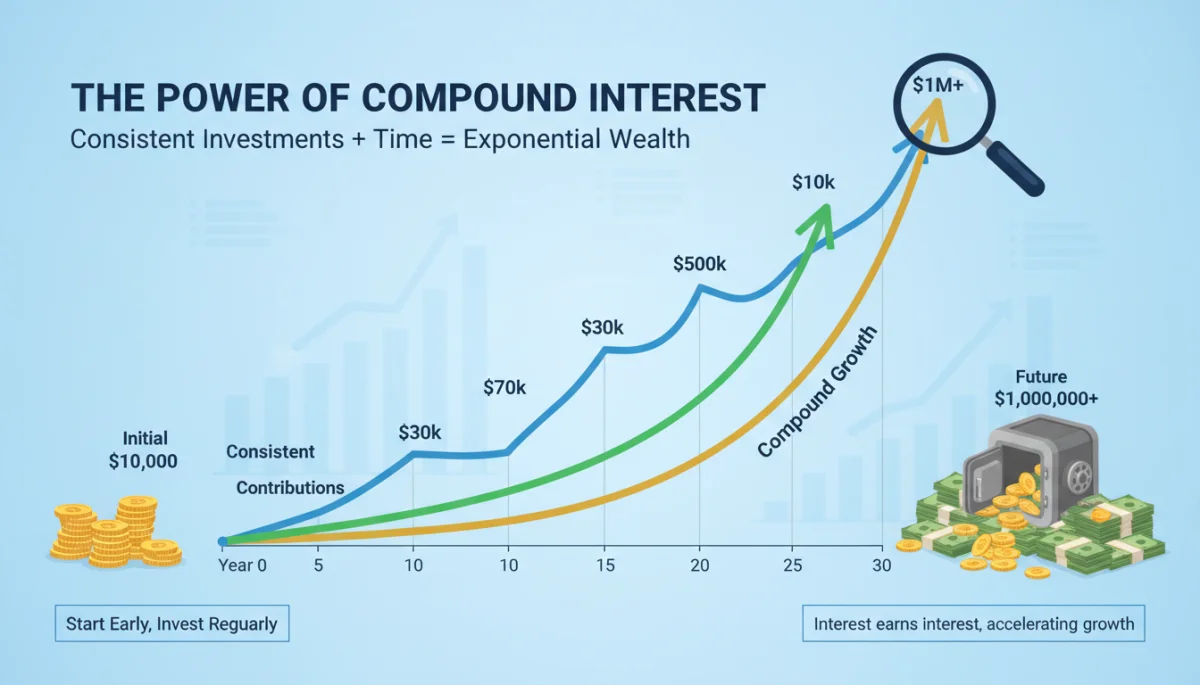
Compound interest is often called the eighth wonder of the world, and for good reason. It allows your investments to grow exponentially over time, as the interest you earn begins to earn interest itself. The earlier you start, the more time compounding has to work its magic.
For example, if you start saving at 25, you’ll need to save significantly less per month than if you start at 45 to reach the same goal. This highlights the urgency of beginning your retirement planning for 2026 today. Even modest contributions made consistently can lead to substantial wealth accumulation over several decades.
Calculating Your Monthly Savings Target
To reach $1 million by age 65, you’ll need to work backward from your target age. Use online retirement calculators or consult with a financial advisor to determine the exact monthly contribution required. These calculations typically factor in your current age, desired retirement age, estimated rate of return on investments, and inflation.
- Utilize online retirement calculators to estimate monthly savings needs.
- Adjust your savings rate based on your current age and investment growth assumptions.
- Re-evaluate your target annually to stay on track.
It’s important to be realistic with your expected rate of return. While historical stock market returns have been strong, future returns are not guaranteed. A conservative estimate can help ensure you don’t fall short of your goal.
Maximizing Retirement Accounts and Investment Strategies
Choosing the right investment vehicles is paramount for efficient wealth accumulation. Various retirement accounts offer tax advantages that can significantly boost your savings. Understanding these options and formulating a robust investment strategy are key components of successful retirement planning for 2026.
Leveraging Tax-Advantaged Accounts
Employer-sponsored plans like 401(k)s and individual retirement accounts (IRAs) such as Roth IRAs or Traditional IRAs are powerful tools. They allow your money to grow tax-deferred or tax-free, depending on the account type.
- Contribute at least enough to your 401(k) to get the full employer match – it’s free money.
- Max out contributions to Roth or Traditional IRAs based on your income and tax situation.
- Explore Health Savings Accounts (HSAs) if eligible, as they offer a triple tax advantage.
These accounts are designed to encourage long-term savings, and their tax benefits can translate into hundreds of thousands of dollars saved over your working life.
Diversifying Your Investment Portfolio
A diversified portfolio spreads your investments across various asset classes to minimize risk and maximize returns. This typically includes a mix of stocks, bonds, and potentially real estate or other alternative investments.
The allocation should align with your risk tolerance and time horizon. Younger investors with a longer time horizon can generally afford to take on more risk, leaning more heavily into equities. As you approach retirement, a more conservative approach with a higher allocation to bonds might be appropriate to protect your accumulated wealth.
Navigating Market Fluctuations and Staying Disciplined
The financial markets are inherently volatile, and it’s easy to get swayed by short-term ups and downs. Maintaining discipline and a long-term perspective is crucial for staying on track with your retirement planning for 2026 goal.
Avoiding Emotional Investment Decisions
Market downturns can be unsettling, but selling investments during a panic often locks in losses and prevents you from participating in the subsequent recovery. Similarly, chasing hot stocks can lead to speculative behavior rather than strategic investing.
Adhere to your predetermined investment strategy, which should be based on your financial goals and risk tolerance, not on daily market headlines. Regular rebalancing of your portfolio can help you maintain your desired asset allocation without making emotional decisions.
Regularly Reviewing and Adjusting Your Plan
Your financial situation and life circumstances will evolve, and your retirement plan should too. Annual reviews are essential to ensure you’re still on target. This includes reassessing your income, expenses, investment performance, and any changes to your personal life, such as marriage, children, or career shifts.
If you find yourself off track, make adjustments promptly. This might involve increasing your savings rate, reallocating investments, or even revising your retirement age. The key is to be proactive and adaptable, ensuring your plan remains relevant and effective.
The Importance of Professional Guidance
While this guide provides a comprehensive overview, the complexities of financial planning can often benefit from professional expertise. A qualified financial advisor can offer personalized advice, help you navigate intricate tax laws, and keep you accountable.
Finding the Right Financial Advisor
Look for a fee-only financial advisor who acts as a fiduciary, meaning they are legally obligated to act in your best interest. Interview several advisors to find one whose philosophy aligns with yours and who can clearly explain their approach.
- Seek a fee-only fiduciary advisor for unbiased advice.
- Ensure they have experience with retirement planning and investment management.
- Look for clear communication and a transparent fee structure.
A good financial advisor becomes a partner in your journey, offering insights and strategies tailored to your unique situation, helping you overcome obstacles, and celebrating your successes.
Benefits of Professional Financial Planning
Beyond investment advice, a financial advisor can help with estate planning, insurance needs, and tax optimization strategies. Their holistic approach ensures all aspects of your financial life are working in concert towards your retirement goal.
They can also provide valuable perspective during market volatility, helping you to remain calm and focused on your long-term objectives. Their expertise can be invaluable in making informed decisions that significantly impact your ability to reach $1 million by age 65.
| Key Aspect | Brief Description |
|---|---|
| Start Early | Leverage compound interest by beginning your savings journey as soon as possible. |
| Maximize Accounts | Utilize 401(k)s, IRAs, and HSAs for tax-advantaged growth. |
| Diversify Investments | Spread investments across asset classes to manage risk and enhance returns. |
| Regular Review | Periodically review and adjust your plan to align with life changes and market conditions. |
Frequently Asked Questions About Retirement Planning
▼
The exact amount depends on your current age, investment returns, and inflation. For someone starting at 30, it might be around $1,000-$1,200 monthly, assuming an 8% annual return. Younger starters need less, older starters need more. Online calculators can provide a personalized estimate.
▼
Highly recommended vehicles include 401(k)s, Roth IRAs, and Traditional IRAs due to their tax advantages. Diversified portfolios of low-cost index funds or ETFs within these accounts are generally effective for long-term growth and risk management.
▼
Diversification across asset classes (stocks, bonds, real estate) helps mitigate risk. Regular rebalancing ensures your portfolio stays aligned with your risk tolerance. Avoiding emotional decisions during market downturns and maintaining a long-term perspective are also crucial strategies.
▼
Whether $1 million is sufficient depends heavily on your desired lifestyle, location, and healthcare costs. For some, it may be ample, especially with Social Security benefits. For others, particularly those with higher spending habits or significant medical needs, more might be necessary. Personalize your goal.
▼
The sooner, the better. Starting in your 20s or early 30s provides the maximum benefit from compound interest, requiring smaller monthly contributions. Even if you start later, consistent and increased savings can still lead to a substantial nest egg, but the journey will be more challenging.
Conclusion
Achieving a $1 million retirement fund by age 65 through dedicated retirement planning for 2026 is an ambitious yet entirely feasible goal. It demands a clear vision of your post-working life, a realistic assessment of your current financial standing, and disciplined execution of a well-thought-out savings and investment strategy. By leveraging the power of compound interest, maximizing tax-advantaged accounts, and making informed investment decisions, you can systematically build the wealth needed to secure your golden years. Remember, the journey is dynamic, requiring regular review and adjustments, and professional guidance can be an invaluable asset. Start today, stay committed, and look forward to a financially secure and fulfilling retirement.
